

The Operating System for Domestic Rail
🛤️ The largest domestic rail shippers in North America are using OpenTrack to predict container availability within 35 minutes, eliminate dry runs, and turn their daily routine from a reactive scramble into proactive execution. They're seeing potential savings in the tens of millions. Here's how the product works, and why some of the biggest intermodal operations in the country are adopting it as fast as they can.
Domestic Rail Is Still a Black Box
Your team is refreshing railroad portals. Calling customer service lines. Maintaining spreadsheets that are stale by the time standup starts. And every morning, the same questions come up:
- When should we send the truck, and will anyone tell us when it's actually available?
- What's still out there, and is anything stuck?
- Which ramps are costing us money?
These aren't new questions. But the answers have been remarkably hard to get, and when you're moving thousands of containers per month, the cost of not knowing compounds fast: demurrage, dry runs, detention, and an operations team that's always looking backward instead of forward.
Now there's an alternative.
The Three Questions Every Domestic Rail Operation Needs to Answer
Whether you own the containers or coordinate the pickups, the questions are always the same.
1. "When should we send the truck?"
You know the drill. The train arrives, but the container isn't available yet. Nobody tells you when it will be. Your team refreshes a railroad portal, does the mental math, and hopes the driver doesn't show up six hours too early or a day too late. You've eaten the dry runs. You've paid drivers to sit at the gate. You've watched demurrage accrue because a container went available and nobody on your team noticed until it was too late.
What if you could see, days in advance, exactly when each container is predicted to become available, broken down by ramp and time window? What if you could book trucking on Monday for pickups through Wednesday with real confidence, instead of scrambling the morning of?
🎯 OpenTrack's Estimated Time of Notification (ETN) is the first comprehensive model for domestic rail to predict not just when a container will arrive, but when it will actually be available for pickup. It accounts for terminal-specific processing patterns, time of day, and day of week, and improves continuously as more data flows through each ramp. No one else in the industry is doing this.
OpenTrack's ETN turns this from a guessing game into a planning exercise.
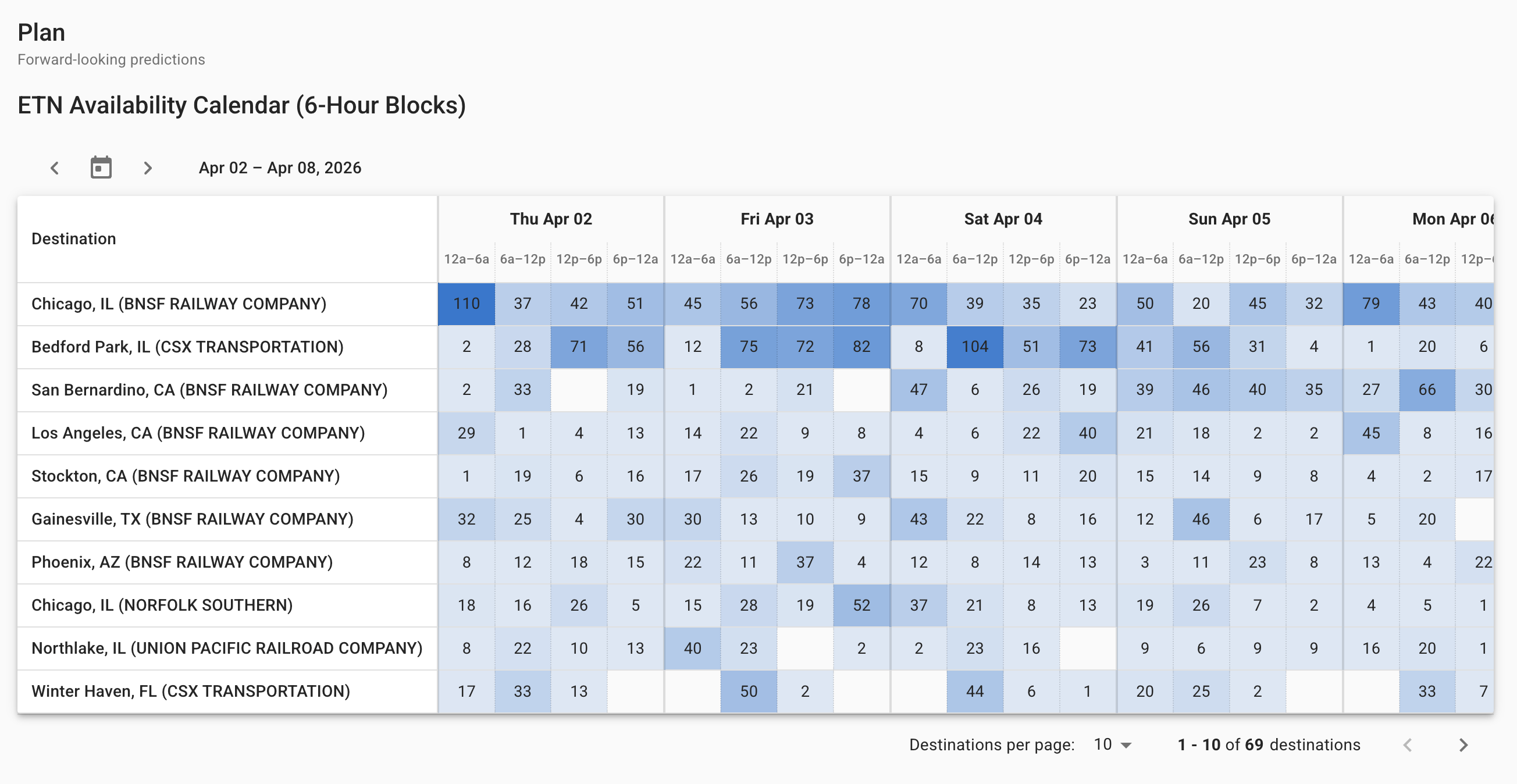
- 6-hour-block calendar view shows exactly how many containers are predicted to become available at each ramp in each window. Look at it Monday morning, book trucking through Wednesday with confidence.
- ~35-minute average accuracy at high-volume terminals, tightening every week. The best estimates elsewhere in the industry land around plus-or-minus 8 to 12 hours.
- Push notifications when a container actually becomes available, so no one on your team has to refresh a railroad portal ever again.
- Advance-booking discounts become capturable when you can commit to trucking days out instead of scrambling to dispatch hours before.
At scale, the savings are enormous. One of the largest domestic intermodal shippers in the country has estimated the potential impact of better arrival-to-available predictions in the tens of millions of dollars annually, driven by reduced dry runs, avoided detention, and tighter last-free-day management.
2. "What's still out there, and is anything stuck?"
You've had a container show up as "delivered" in your system when it was actually sitting at an intermediate terminal waiting for a second rail leg. You've lost track of empties for a week because nobody re-entered them after delivery. You've tried to piece together a crosstown move from two separate carrier portals and given up halfway through.
What if every container, laden or empty, single-leg or crosstown, just stayed visible from first ingate to final outgate, without your team having to re-upload or manually stitch anything together?
OpenTrack eliminates these blind spots with a set of capabilities no one else offers all in one place.
- Standardized milestones on every journey: ingate, loaded on rail, departed, arrived, unloaded, available, outgated. Every container, every railroad, every time. The time between any two milestones (origin dwell, rail transit, arrived-to-available, destination dwell, street dwell) is automatically calculated, giving you precision analytics to zero in on exactly where the bottlenecks are.
- Continuous tracking: with this optional feature, once an equipment number is in the system, we monitor for new waybills automatically. Laden journey ends and the container goes empty? Tracked. Empty repositions to a new origin? Tracked. The container never goes dark.
- Crosstown stitching: multi-leg moves sharing the same house bill are automatically combined into a single end-to-end journey. No manual linking required.
- Segmented transit time charts, sorted by volume, break each journey into its component segments so your team can see at a glance whether the bottleneck on a Chicago-to-New-York crosstown is the origin dwell, the first rail leg, the dray in the middle, or the destination terminal.
3. "Which ramps are costing us money?"
You already know destination dwell is killing you. You see it every month when the invoices come in. The question isn't whether it's a problem; it's that by the time you find out which ramp, which containers, and how long, the money is already gone.
What if you didn't have to wait for the invoice? What if you knew, right now, which containers are approaching their last free day, which ramps are running hotter than normal, and which pickups need to happen today before the charges start?
OpenTrack makes that real.
- Demurrage risk alerts fire when a container's last free day is today, or when it has been dwelling longer than 80% of containers at the same terminal. You get the warning while there's still time to dispatch a driver.
- Live dwell dashboards show destination and origin dwell by ramp, bucketed into actionable ranges (<12h, 12-24h, 24-48h, 48h+), sorted by volume so your worst-performing ramps are always at the top. Click any bar to see the exact containers.
- Origin dwell surfaces where things are getting stuck upstream: a container sitting at a ramp because it missed a cutoff is a day-late delivery waiting to happen. You catch it before it cascades.
Your team starts the day knowing which ramps need attention, instead of spending the first 30 minutes pulling data to figure it out.
You've probably looked at domestic rail visibility tools before. Maybe you tried a legacy aggregator and got burned by per-event billing that made costs unpredictable at scale. Maybe you evaluated an enterprise platform that bundled ten things you didn't need at a price you couldn't justify. Maybe you just kept doing it manually because nothing out there felt like it was built by people who actually understood the workflow.
Why Teams Are Switching to OpenTrack
Here's what's different about OpenTrack:
- Just the equipment number and you’re tracking. No waybill, no SCAC code, no master bill. Give us a container number and we discover everything else automatically. We connect directly with all Class 1 carriers (UP, BNSF, CSXT, NS, CN, CP/CPKC) and use industry data aggregators for Class 2 and Class 3 coverage. Containers, railcars, laden, empty.
- Built with operators, not just for them. Every feature above was designed alongside teams running domestic rail at scale, both shippers managing their own containers and drayage carriers coordinating thousands of pickups. This is not a generic dashboard bolted onto a data feed.
- We ship fast. During our most recent large-scale deployment, the customer asked for empty voyage tracking and crosstown stitching. Both were live in under a week. When their ops team requested new columns in the dwell reports, those changes shipped to production in days. This isn't a vendor that takes six months to add a field.
- Predictable pricing. Simple per-equipment-voyage price. No per-event billing that explodes with volume. No surprise invoices when you go from pilot to full-scale.
- Live in days, not months. We recently onboarded tens of thousands of containers for one of the world's largest domestic intermodal shippers. No multi-month integration, no IT involvement on the customer side. Upload a CSV with equipment numbers and you're tracking. API available if you want it, but you don't need it to start.
The Bottom Line
You already know what it costs to run your operation blind. The demurrage invoices. The dry runs. The drivers sitting at gates. The scramble every afternoon when you're not sure if something went available and nobody told you.
The largest domestic intermodal operations in North America are already using OpenTrack because they got tired of paying for that uncertainty. The tools exist to go from reactive to proactive. The question is how long you keep doing it the hard way.
Ready to see what your operation looks like in OpenTrack? Talk to us about a pilot.

_500.png)