

Most companies today are focused on checking the visibility box.
Do we have the data? Can we see what’s happening? Is there a dashboard someone can pull up?
That kind of visibility feels like progress. But it still puts a human in the middle. Someone has to look, decide, and act. The system informs the work — it doesn’t run it.
Unlocking autonomy is different.
Autonomy is when the data is good enough that the system can move without waiting on people. Decisions happen automatically. Humans step in only to handle exceptions.
That’s the Autonomy Threshold.
This is where outcomes start to diverge. Teams stuck at “visibility” scale by adding people and process. Teams that cross the threshold remove entire decision steps. Speed compounds. Costs flatten. Learning accelerates.
The difference isn’t ambition or tooling. It’s data quality.
Most teams made reasonable decisions: buying affordable data that was “good enough” for a world where humans were always in the middle.
That world just ended.
AI has exposed this gap — and then widened it.
Here’s what that divergence actually looks like:
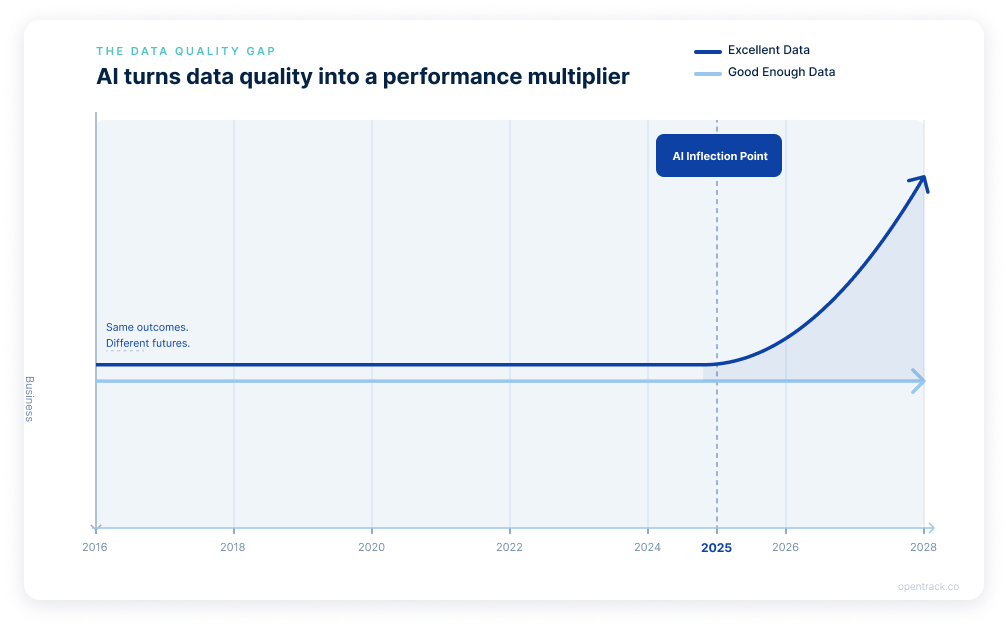
For a long time, the difference between “good enough” data and excellent data was not transformative.
That’s why the two lines in the chart start flat and close together. Both kinds of companies looked fine. Both could claim visibility. Both relied on humans to interpret what the data meant and decide what to do next.
In that world, data quality was helpful — but not decisive.
Then something changed.
Around 2025, systems stopped just showing information and started acting on it. AI moved from copilots and dashboards into decision paths, workflows, and automation.
That’s the inflection point.
And it’s where the Autonomy Threshold suddenly mattered.
Why One Line Shoots Up, and the Other Doesn't
After the inflection point, the lines don’t just separate — they behave fundamentally differently.
“Good Enough” Data Stays Flat
With data that’s mostly right but not fully trustworthy, humans stay in the loop.
Every automation needs oversight. Every alert needs judgment. Every decision slows down to manage risk. AI adds surface area, but not leverage.
The organization stays busy — but performance plateaus.
This is the flat blue line.
Excellent Data Unlocks Autonomy
With reliable, structured, trustworthy data, systems can act without waiting.
Workflows run end-to-end. Decisions happen automatically. Exceptions are rare and meaningful. Humans focus on what’s novel, not what’s repetitive.
Once that happens, performance doesn’t just improve — it accelerates.
That’s the green line shooting upward.
Not because the company became smarter overnight, but because it finally crossed the Autonomy Threshold at exactly the moment AI turned that threshold into a multiplier.
What Changes on the Right Side of the Threshold
The vertical gap in the chart comes from very concrete shifts.
Automation stops needing supervision. Below the threshold, an automated customer notification still needs someone to verify the ETA before it goes out. Above it, the data is trusted enough to send on its own, across hundreds of shipments, without a human reviewing each one.
Analytics start shaping decisions. Below the threshold, a weekly report tells you which lanes were slow last month. Above it, the system identifies a developing port congestion pattern and reroutes bookings before the delay hits.
Exceptions get smaller instead of louder. Below the threshold, an ops desk gets 200 alerts a day and learns to ignore most of them. Above it, they get 15 alerts that each mean something, and they act on them in minutes instead of triaging for hours.
Transparency becomes safe. Below the threshold, sharing live tracking with a customer is risky because the data might be wrong or stale. Above it, you give customers a live view with confidence, and that trust compounds into retention.
Each of these changes reinforces the next. That's the positive feedback loop, and why the green line doesn't just rise, it accelerates.
The Key Takeaway
Many companies will fall behind not because they lacked visibility, but because their data never quite crossed the threshold where systems could be trusted to run on their own.
Below the Autonomy Threshold, data helps you see. Above it, data lets the business move faster than people ever could on their own.
We built OpenTrack around this conviction. Normalizing data across dozens of sources and formats. Investing in data quality that most platforms treat as someone else's problem. Because the companies that cross this threshold first will be the ones that pull away.
To see what this looks like in practice, read how one drayage provider used OpenTrack's visibility and exception management to boost on-time delivery without adding headcount.

_500.png)